______________________________________________________________________
By Mira Zylali and Sharon Lamberton
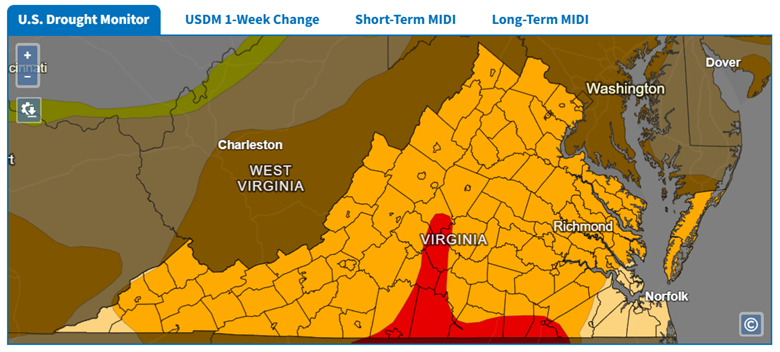
Virginia is officially in a drought.
According to the National Integrated Drought Information System, “Virginia generally receives over 40 inches of precipitation per year and is historically considered ‘water rich.’ However, droughts are not uncommon, and Virginia has a history of multi-year droughts.”1 As of May 1, the U.S. Drought Monitor map on the NIDIS website showed 85.9% of Virginia as being in a state of “severe drought.”2
While planting native can’t prevent a drought, native plants, especially grasses, can help mitigate the compounding impacts of an extended drought.
Native plants are specially evolved to survive in our local environment. They adapted, over millions of years, to serve specialized niches here in Virginia and hold out against a variety of conditions, including drought.
The deep roots of some Virginia native plants access water that shorter, non-native turf lawns cannot. Once established, they require far less irrigation. They also do a superior job of filtering rainwater and reducing flooding problems, helping us all have access to cleaner, safer water.
These deep and complex root networks stabilize the soil, preventing post-drought flooding that can occur when earth is too dry and cannot absorb a deluge of water all at once. Their roots also create pathways that allow water to absorb into the earth more effectively while holding the soil together. This improvement in soil health, in turn, allows the soil to hold more water, helping prevent drought in the first place.
Think about how much easier it is to hold onto something with all of your digits as opposed to just your index finger. Now imagine trying to do it on a slip-and-slide.
A few favorite native drought resistant plants are listed below. The taller you allow the plant to grow, the deeper the roots are able to reach. A * indicates a keystone species. You can also take a look at the Greater Richmond VA Wild Ones handout on drought resistant plants here.
Grasses
Purple Love Grass, Tumblegrass, Eragrostis spectabilis
Giant Plumegrass, Erianthus giganteus, or Saccharum giganteum
Hair-awn Muhly, Pink Muhlygrass, Muhlenbergia capillaris
Panicum virgatum, Switchgrass
Schizachyrium scoparium, Little Bluestem*
Sorghastrum nutans, Indian Grass
Perennials
Stonecrop, Sedum ternatum
Black-eyed Susan, Rudbeckia hirta*
Bloodroot, Sanguinaria canadensis
Mayapple, Podophyllum peltatum
Iris cristata, Dwarf Crested Iris
Yellow Wild Indigo, Baptisia tinctoria
Wild or Eastern Red Columbine, Aquilegia canadensis
Butterfly-weed, Asclepias tuberosa
Eastern prickly pear cactus, Optunia
Blue False Indigo, Baptisia australis
New York Ironweed, Vernonia noveboracensis
Rattlesnake master, Eryngium yuccifolium
Goldenrod, Solidago*
Aster, Aster*
Smooth Beard-tongue, Penstemon laevigatus
Cut-leaf Sunflower, Green-headed Coneflower, Rudbeckia laciniata*
Vines
Coral honeysuckle, Lonicera sempervirens
Yellow jessamine, Gelsemium sempervirens
Trumpet creeper, Campsis radicans
Passion vine, Passiflora incarnata
Shrubs
Beautyberry, Callicarpa Americana
Sumac, Rhus species
Blueberries, Vaccinium species*
Native viburnums, Viburnum species
Grey dogwood, Cornus racemosa
New jersey tea, Ceanothus americanus
Ferns
Christmas fern, Polystichum acrostichoides
Sources
1. From “Drought in Virginia,” at https://www.drought.gov/states/virginia#drought-overview
2. https://www.drought.gov/states/virginia#current-conditions
3. https://www.deq.virginia.gov/home/showpublisheddocument/32729/639026074417130000
4. Plant list credited to the Virginia Native Plant Society Group, Master Gardeners of Northern Virginia, Janis Miller.